
The True Meaning of Navavidha Bhakti by Sai Baba
The Leela
Anantrao Patankar was no ordinary man; he was a titan of intellect, a scholar who had mastered the four Vedas, the six Shastras, and the Upanishads. Yet, despite his vast library of knowledge, his heart was a barren desert, devoid of peace. He observed simple, unlettered devotees in Shirdi brimming with a tranquility that eluded him, the learned Pandit. Driven by this desperate restlessness, he approached Sai Baba and confessed, 'I have read everything, yet I am a pauper in spirit. Grant me the peace that these simple souls possess.'
Baba, with his characteristic mystique, did not offer a philosophical discourse. Instead, He told a parable: 'There was a merchant. Before him, a mare dropped nine balls of dung. The merchant, seeking peace, gathered all nine balls and thus attained the treasure of tranquility.'
Patankar was baffled. A mare? Dung balls? What kind of instruction is this? Seeing his confusion, a fellow devotee decoded the metaphor: The mare represents God's Grace, and the nine dung balls symbolize Nav Vidha Bhakti—the nine ways of devotion. Patankar realized that while he had spent a lifetime sharpening his intellect, he had completely neglected the culture of the heart. He had never shed a tear of love nor bowed in true surrender. That day, the scholar prayed not for more knowledge, but for the humble capacity to gather the nine gems of devotion.
? The Conflict / Doubt
Can intellectual mastery of scriptures substitute for the experience of divine love? Anantrao Patankar represents the classic spiritual conflict: he possessed Jnana (knowledge) of the texts but lacked Bhakti (devotion) and Shanti (peace). His doubt was existential—why did his profound learning leave him restless, while simple faith brought others bliss?
The Revelation
Sai Baba teaches that true devotion is not a part-time activity but a total withdrawal of the mind from worldly attachments to fix it exclusively on the Sadguru. The path to peace lies in the nine forms of devotion:
- Shravana (Listening): The 'engine' of devotion. It is not just hearing but deep, attentive listening to the Guru's words and divine glories with a receptive heart.
- Kirtana (Singing/Praising): Going beyond musical entertainment. True Kirtana moves from the body to the soul, where the singer dissolves in the meaning of the praise.
- Vishnu Smarana (Remembrance): Not mechanical repetition (Ratana) but constant mental awareness (Smarana). Like a woman carrying water pots who talks to friends but keeps her focus balanced on the pot, one must live in the world without losing focus on the Divine.
- Padasevana (Service): Anticipating the Guru's needs before they are spoken. It is the difficult path of serving with the alertness of Lakshmana, who removed thorns from Rama's path before he even walked it.
- Archana (Worship): The surrender of body, mind, and wealth. It is the external ritual performed with internal totality.
- Vandana (Salutation): 'Na-Man'—meaning 'not my mind.' It is the surrender of the ego, living 24/7 according to the Guru's will rather than one's own desires.
- Dasya (Servitude): Becoming the 'servant of the servant.' Cultivating such humility that one becomes like grass under the feet of the Lord's devotees.
- Sakhya (Friendship) & Atma Nivedanam (Self-Surrender): The final stages are the Guru's gift (Prasad), where the Divine treats the devotee as a friend and ultimately merges with them in non-dual unity.
"I do not want your divided love... Wherever your mind is attached, withdraw it first... Gather that collected mind and pour it at the feet of the Sadguru."
Scriptural References
📖 Sai Satcharitra Chapter 21 (Nav Vidha Bhakti), Chapter 10; Guru Charitra Chapter 2 (Deepak Akhyan); Narada Bhakti Sutras.
Watch the Discourse
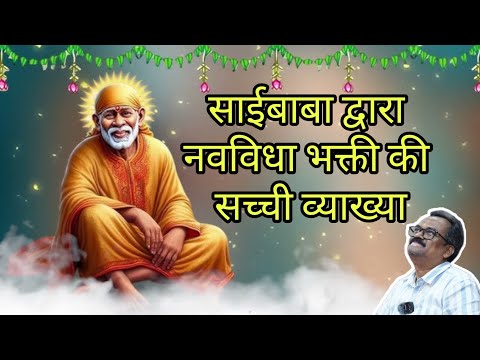
Anantrao Patankar was no ordinary man; he was a titan of intellect, a scholar who had mastered the four Vedas, the six Shastras, and the Upanishads. Yet, despite his vast library of knowledge, his hea...
Leela Narration
Anantrao Patankar was no ordinary man; he was a titan of intellect, a scholar who had mastered the four Vedas, the six Shastras, and the Upanishads. Yet, despite his vast library of knowledge, his hea...