
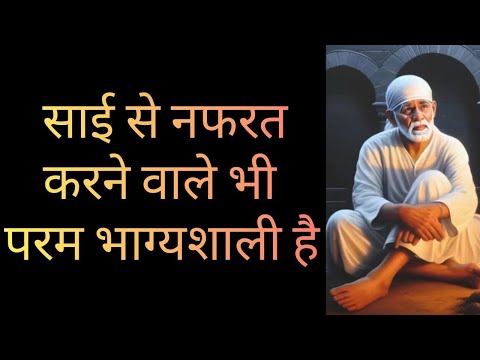
Even those who hate Sai are extremely fortunate.
The Leela
In the bustling age of social media, where information travels faster than light, a cloud of doubt often hovers over the faithful. New devotees, innocent in their longing, find their faith shaken by questions thrown like stones: 'Was Sai Baba a Muslim? Did he eat meat? Why did he smoke a chillum?' These whispers of 'Chand Miyan' and accusations of non-Sanatani behavior aim to diminish the glory of the Saint of Shirdi.
Yet, amidst this noise, a profound truth emerges—not as a defense, but as a revelation of Baba's cosmic nature. The speaker reminds us that Baba is not an ordinary entity to be measured by human standards of diet or dress. He recalls the metaphorical 'Teli' (selfish, clingy devotees) and 'Tamboli' (critics or cleaners) mentioned by Baba. Just as the betel leaf (Tamboli) cleanses the palate after a greasy meal, the critics unknowingly participate in a divine leela.
But the most striking imagery comes from Baba's own lips. He describes Himself not merely as a stone, but as the Paras (Philosopher's Stone). When skeptics, armed with the heavy iron pillars of hatred and criticism, strike at Him to prove He is just a common stone, a miracle occurs. The moment the iron touches Him—even with the intent to harm—it is transmuted into gold. The hatred dissolves, leaving behind only the precious metal of spiritual transformation. Thus, the speaker posits a daring thought: 'Those who hate Baba are the most fortunate people of Baba.' For even in their hate, they have touched the Paras, and their destiny is now gold.
? The Conflict / Doubt
How can a true Saint or Sadguru engage in worldly behaviors such as eating meat, smoking a chillum, or being associated with a specific religion like Islam ('Allah Malik'), and how should a devotee respond when such accusations shake the foundation of their Shraddha (faith)?
The Revelation
The confusion arises when we attempt to measure the Infinite with the yardstick of the finite. The transcript offers a profound spiritual perspective on dealing with criticism and the nature of a Sadguru:
-
The Unaffected State of the Sadguru: Citing the poet Rahim, the teaching explains that just as a sandalwood tree remains fragrant and pure even when poisonous snakes wrap around it, a realized being (Yoga Emperor) remains untouched by external actions like eating meat or smoking. These actions were often skillful means to reach devotees at their level to eventually lift them up.
"Rahim says, what can bad company do to one of good nature? Sandalwood is not affected by poison even if snakes remain wrapped around it."
-
The Alchemy of Contact: The most powerful teaching is the metaphor of the Paras (Philosopher's Stone). Critics are like iron pillars striking Baba. While their intent is to prove He is ordinary stone, the contact itself transforms their 'iron' nature into spiritual 'gold'.
"I am not Paras, I am a stone... To prove this, they bring iron poles and hit the stone. And in return, that iron pillar turns into gold."
-
The Salt Doll Analogy: Attempting to analyze Baba's divinity with limited logic is futile. Like a salt doll entering the ocean to measure its depth, the critic dissolves into the very vastness they sought to question.
-
Response to Hate: Devotees are urged not to counter hate with hate. Since Baba transforms even His haters into gold, devotees should view them with compassion and focus solely on spreading Baba's spiritual treasure—the Sai Satcharitra.
Scriptural References
📖 Sai Satcharitra Chapter 23 (Onion/Yoga), Chapter 28 (Megha), Chapter 42 (Teli-Tamboli), Chapter 44 (Paras Stone Metaphor)
Watch the Discourse
In the bustling age of social media, where information travels faster than light, a cloud of doubt often hovers over the faithful. New devotees, innocent in their longing, find their faith shaken by q...
Leela Narration
In the bustling age of social media, where information travels faster than light, a cloud of doubt often hovers over the faithful. New devotees, innocent in their longing, find their faith shaken by q...