
Sai Baba's Unique Mode of Sleeping
The Leela
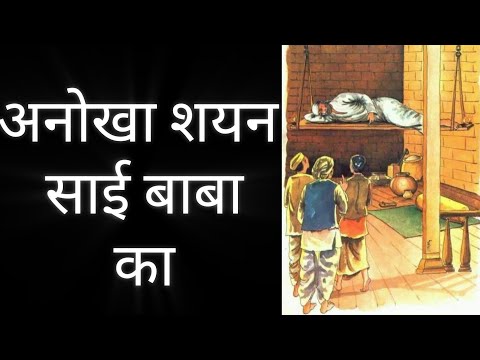
In the sacred atmosphere of Dwarkamai, a marvelous spectacle unfolded that baffled the logic of Shirdi’s residents. Sai Baba, the supreme Yogi, possessed a wooden plank—a simple, narrow board. Yet, His use of it was anything but ordinary. Baba suspended this plank nearly twelve feet above the ground, supported merely by tattered rags that seemed too fragile to hold even the wood’s weight, let alone a human body. On this precarious perch, Baba would sleep, placing two lit lamps—one at His head and one at His feet.
The villagers were consumed by curiosity. How does He climb up without a ladder? How do those rags hold Him? Observers watched intently, hoping to catch the secret, but Baba’s movements remained a mystery, often performed in solitude or through the mastery of yogic powers like assuming a subtle form. Eventually, weary of the public's intrusive scrutiny, Baba broke the plank and cast it into the Dhuni.
Years later, the devoted Kaka Saheb Dixit, remembering this unique Leela, offered to arrange another suspended plank for Baba. Baba gently refused. When Dixit persisted, suggesting he could at least arrange one for the devotee Mhalsapati to sleep above while Baba slept below, Baba revealed the profound truth: sleeping on such a height is not a mere physical act, but a feat reserved for those who have conquered the very nature of sleep itself.
? The Conflict / Doubt
❓ Doubt: The Physical Impossibility The people of Shirdi were fixated on the physical mechanics: How could weak rags bear the weight? How did Baba ascend 12 feet without aid? Decades later, Kaka Saheb Dixit mistakenly viewed the plank as a matter of comfort or hierarchy, failing to realize that "sleeping high" was a metaphor for a spiritual state that an ordinary person, weighted down by body-consciousness, could not sustain.
The Revelation
💡 Revelation: The State of Pure Awareness Baba used this conversation to explain that the plank was not just a bed, but a symbol of dwelling in the Chidakash (Infinite Sky of Consciousness).
- The Light of Consciousness: The lamps at His head and feet symbolized that His entire being—from the Muladhara to the Sahasrara—was filled with divine light. He had transcended body-consciousness.
- Conquering Sleep: Baba explained that ordinary sleep renders a human "heavy as a stone" due to the loss of awareness. A stone cannot float in the sky. To sleep on the plank required a state where the eyes might be closed, but the inner consciousness remains fully awake.
"Nahi phadevar shain sope... nain ughade nidra lope." (Sleeping on the plank is not easy; only he whose eyes remain open while sleep vanishes can do it.)
- The Rags and the Soul: The tattered rags represent the fragile connection to the physical body. Only when the soul sheds the heavy burden of worldly existence can it float in the spiritual sky, supported by the finest threads of faith.
"Do you think resting on a cot is a simple thing? It’s not for everyone; not everyone can manage it."
Scriptural References
📖 Sai Satcharitra Chapter 10, Sai Satcharitra Chapter 45
Watch the Discourse
In the sacred atmosphere of Dwarkamai, a marvelous spectacle unfolded that baffled the logic of Shirdi’s residents. Sai Baba, the supreme Yogi, possessed a wooden plank—a simple, narrow board. Yet, Hi...
Leela Narration
In the sacred atmosphere of Dwarkamai, a marvelous spectacle unfolded that baffled the logic of Shirdi’s residents. Sai Baba, the supreme Yogi, possessed a wooden plank—a simple, narrow board. Yet, Hi...