
The Mirror of Divinity: Decoding the True Marks of a Sadguru
The Leela
The atmosphere vibrates with the ancient resonance of the Guru Gita: 'Brahmanandam parama sukhadam kevalam jnaanamurtim...' These words are often chanted, yet their profound depth remains unexplored by many. Imagine a seeker standing amidst the noise of the world, looking for a beacon of truth. In the silence that follows the chant, a question arises: Who is truly a Sadguru?
The discourse unfolds not as a lecture, but as a journey through the very anatomy of the Divine. The narrator invites us to look beyond the physical form. We see the world as a chaotic interplay of opposites—the heaviness of the earth contrasting with the lightness of air, the burning heat of fire against the cooling touch of water. In this vast design of the Creator, humanity is trapped in the pendulum of duality—joy and sorrow, day and night, honor and insult. Yet, amidst this storm stands the Sadguru, described in the verse not merely as a person, but as a state of being: Dvandvaateetam (beyond dualities) and Gagana Sadrusham (vast as the sky).
The narrative guides us to realize that while our existence is confined to chairs and rooms, limited by the body, the Sadguru is Ekam Nityam—the One Eternal Reality that was, is, and always will be, transcending the birth and death of the physical frame. It is a portrait of figures like Sai Baba, Swami Samarth, and Gajanan Maharaj, who embody these celestial qualities.
? The Conflict / Doubt
In the age of Kaliyuga, where self-proclaimed guides appear in every alley, how can a seeker distinguish a genuine Sadguru from a pretender? What are the definitive qualities that mark a soul as having attained the supreme state of Brahman?
The Revelation
The Guru Gita verse acts as the ultimate checklist for identifying a Sadguru. The revelation breaks down the Sanskrit definitions into spiritual criteria:
-
Brahmanandam (Bliss of Brahman): A Sadguru is in a constant state of divine bliss for twenty-four hours a day. Unlike human happiness, which is fleeting and sensory (often described as mere poison in disguise), their joy is the Paramasukhadam—the supreme, unchanging bliss that never fades.
-
Kevalam Jnana Murtim (Embodiment of Knowledge): They are not just knowledgeable; they are the very form of wisdom, free from even a trace of ignorance.
-
Dvandvateetam (Beyond Dualities): The world is constructed of opposites—day and night, nectar and poison, life and death. While humans are bound by these cycles, the Sadguru has conquered them.
"The Creator has made the world like this, it is made up of dualities... If you are desiring peace, then unrest will also come into your life... But the Sadguru is beyond these dualities."
-
Gagana Sadrusham (Like the Sky): Human existence is limited to the body, but the Sadguru is all-pervasive, omnipresent like the sky.
-
Tatvamasyadi Lakshyam (The Goal of Oneness): The sole purpose of the Sadguru's incarnation is to impart the realization of Tat Tvam Asi—"You are That." There is no separation between the Divine and the devotee.
-
Ekam Nityam Vimalam Achalam: They are One, Eternal, Pure, and Unmovable. While bodies perish, the Guru principle remains constant, steady as a mountain even in the face of death.
-
Triguna Rahitam (Beyond the Gunas): They are untouched by the three modes of nature (Sattva, Rajas, Tamas) and free from worldly attachments and emotions (Bhavateetam).
Scriptural References
📖 Guru Gita
Watch the Discourse
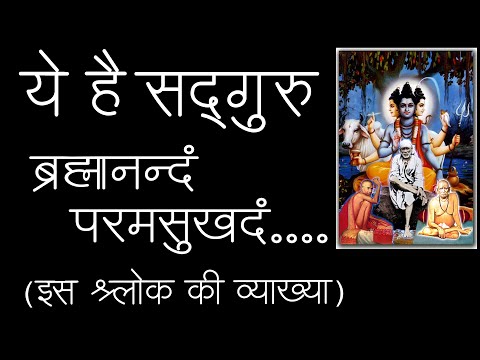
The atmosphere vibrates with the ancient resonance of the *Guru Gita*: *'Brahmanandam parama sukhadam kevalam jnaanamurtim...'* These words are often chanted, yet their profound depth remains unexplor...
Leela Narration
The atmosphere vibrates with the ancient resonance of the *Guru Gita*: *'Brahmanandam parama sukhadam kevalam jnaanamurtim...'* These words are often chanted, yet their profound depth remains unexplor...