
The Chains of Greed and the Freedom of Surrender: The Madrasi Bhajan Leela
The Leela
In the vibrant days of Shirdi, rumors spread as far as Madras that the Saint of Shirdi was distributing vast sums of money. Driven by the allure of material wealth, a 'Madrasi Bhajan Mela'—consisting of a man, his wife, his sister-in-law, and his daughter—diverted their pilgrimage from Kashi to Shirdi. They hoped that by singing bhajans, they might earn a fortune.
The man’s wife had once been a devout soul, blessed with frequent visions of Lord Rama. However, as greed infiltrated her heart, the divine visions ceased. Upon seeing her in Shirdi, Baba’s heart melted. His gaze washed away her inner greed, and instantly, her connection was reestablished; she saw Lord Rama in Baba’s form. Overjoyed, she told her husband, 'I went to see the Saint, but I had the darshan of Lord Rama!'
Her husband, a miser deeply entrenched in materialism, scoffed. 'You women are naive. If it was truly Rama, did He give you money? If He didn't give you 5-10 crores, what is the use of such a vision?'
To cure this deep-seated disease of greed, Baba appeared to the man in a vivid dream. The man found himself in a terrifying jail, bound in heavy chains. Baba stood before him. The man pleaded, 'Baba, why am I suffering? I haven't done anything wrong in this life!' Baba reminded him that he must pay for the karma of past lives. Challenging Baba, the man argued that the sight of a Saint should burn all past sins like dry grass. Baba asked, 'Do you really have that much faith?'
When the man agreed, Baba asked him to close his eyes. Upon opening them, a police officer lay dead, soaked in blood. The man was terrified, realizing he would be framed for murder. With no other hope, he surrendered completely, pleading for Baba to save him. Baba commanded him to close his eyes once more. When he opened them, the chains were gone, the jail vanished, and he was free. He awoke transformed, realizing that while he came to Shirdi seeking coins, he had found the Supreme Lord who liberates the soul from the bondage of ignorance.
? The Conflict / Doubt
Can spiritual experiences act as a substitute for material wealth, and why does the mind dismiss divinity if it does not yield financial profit?
The miserly husband represents the skeptical intellect that weighs the divine on the scales of commerce. He asks:
"If he didn't give you anything, then why are you so happy about your vision?"
The Revelation
Baba's method of teaching reveals how profound suffering is sometimes necessary to break the stubborn chains of attachment.
- The Cure for Greed: Baba explains that when a person is consumed by greed, mere words do not suffice. To remove the disease, He creates a crisis (tribulation) so severe that the mind's attention is forcibly diverted from pleasure and money to the immediate pain. Just as a fever makes one lose appetite for a feast, a crisis makes one lose appetite for greed.
- Avidya vs. Maya: The dream symbolizes the spiritual state. The chains represent Avidya (individual ignorance/Jiva), and the prison bars represent Maya (collective ignorance/Shiva). Baba frees the devotee from both.
- The Necessity of Surrender: The man only found freedom when the situation became hopeless (the murder accusation) and he surrendered completely. When the ego falls, the chains fall.
- True Wealth: Baba transformed the man’s motivation. He promised to provide for the man's necessities saying:
"I will give you money wherever you need it... My invisible hand will keep giving you."
- The Boat Analogy: Echoing Sant Kabir, the teaching concludes:
"Just as a boat is laden with water in a river, wealth accumulates within a house. With both hands expelling out, this is the wise way." Water in a boat sinks it; hoarding wealth sinks the soul.
Scriptural References
📖 Sai Satcharitra Chapter 27 (The story of the Ramadasi/Madrasi Bhajan Group); Sai Satcharitra Chapter 50 (Reference to Avidya and Maya); Sant Kabir Dohe.
Watch the Discourse
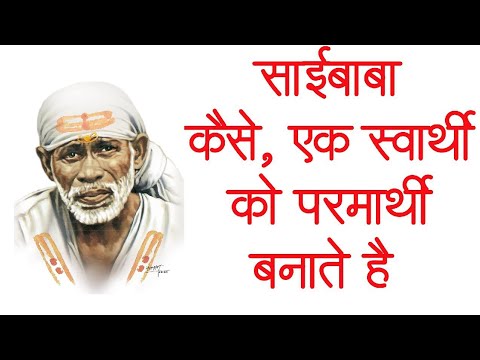
In the vibrant days of Shirdi, rumors spread as far as Madras that the Saint of Shirdi was distributing vast sums of money. Driven by the allure of material wealth, a 'Madrasi Bhajan Mela'—consisting ...
Leela Narration
In the vibrant days of Shirdi, rumors spread as far as Madras that the Saint of Shirdi was distributing vast sums of money. Driven by the allure of material wealth, a 'Madrasi Bhajan Mela'—consisting ...