
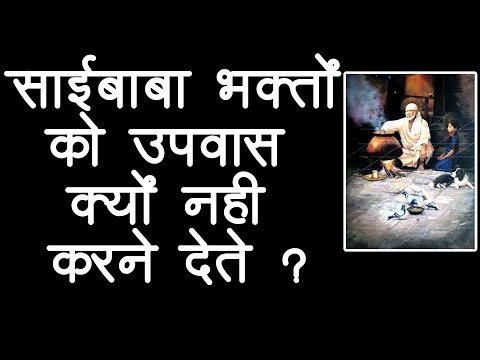
God is Not Found on an Empty Stomach: Why Sai Baba Disapproved of Fasting
The Leela
In Chapter 32 of the Shri Sai Satcharitra, we are introduced to Mrs. Gokhale, a devotee who journeyed to Shirdi with a fierce, albeit misguided, determination. She had resolved to observe a strict three-day fast, refusing to consume a single grain of food or a drop of water, believing this penance would bring her closer to the Divine.
While many saints might encourage such austerity, Sai Baba’s reaction was contrary to the world's expectation. He did not praise her willpower; He dismantled it. Baba directed her to the home of a Brahmin where the mother was unable to cook due to traditional restrictions, leaving her children hungry. Baba instructed Mrs. Gokhale to go there, cook Puran Polis (sweet flatbreads), feed the hungry children, and—crucially—feed herself.
By breaking her fast, Baba was not leading her away from God but guiding her toward the truth: that torturing the physical body renders it useless for spiritual pursuit. He showed her that a day spent serving others with a nourished body is far superior to days spent in self-imposed starvation.
? The Conflict / Doubt
Fasting during holy occasions like Shivratri and Ekadashi is a tradition observed since time immemorial to purify the self. Why did Sai Baba explicitly forbid his devotees from fasting, seemingly contradicting centuries of established spiritual custom?
The Revelation
Sai Baba’s teaching is grounded in the practical reality that the body is the primary instrument for spiritual practice (Sadhana). If the instrument is broken or weak, the music of devotion cannot be played.
- The Illusion of Starvation: Baba taught that when the belly is empty, the mind does not ascend; it scatters. As the verses describe, "the ground beneath turns into the sky," meaning the intellect becomes confused and reality turns topsy-turvy. In such a state, neither meditation nor prayer is possible.
- The Role of the Senses: To worship God, one needs the eyes to see Him, the tongue to chant His name, and the ears to hear His glory. If these senses (Indriyas) are weakened by hunger, they forget their innate abilities. You cannot perceive the Divine with a fainting consciousness.
- The Middle Path: Baba advocated Mit Bhojan (moderate eating). He warned that both gluttony and extreme fasting are dangerous. Eating just enough to sustain the body allows the devotee to focus entirely on the Spirit without being distracted by the cravings of the flesh.
- Service Over Suffering: Instead of lying weak in bed due to fasting, Baba encourages us to eat, gain strength, and use that energy to serve others. That active service is worth the merit of a thousand Shivratri fasts.
Baba’s ultimate verdict serves as a timeless warning to extreme ascetics:
"Bhukelya poti dev sapde, he n ghade kalpanti." (God is never found on an empty stomach, not even until the end of the eon.)
Scriptural References
📖 Shri Sai Satcharitra, Chapter 32
Watch the Discourse
In Chapter 32 of the *Shri Sai Satcharitra*, we are introduced to Mrs. Gokhale, a devotee who journeyed to Shirdi with a fierce, albeit misguided, determination. She had resolved to observe a strict t...
Leela Narration
In Chapter 32 of the *Shri Sai Satcharitra*, we are introduced to Mrs. Gokhale, a devotee who journeyed to Shirdi with a fierce, albeit misguided, determination. She had resolved to observe a strict t...