
The Anguish of the Thirsty Heart: Snatch Everything, But Spare Your Love
The Leela
In the vast theater of spiritual seeking, a poignant drama unfolds within the heart of a devotee. He stands before the merciful Sai Baba, torn by a profound duality. He describes his helpless state with a raw metaphor: his right hand holds his lawful 'wife'—representing the Lord and righteousness—while his left hand tightly grasps a 'girlfriend'—representing the seductive attachment to the material world. He longs to embrace Baba fully, yet he admits, 'I cannot remove all my attachments by myself. I am not capable enough, Baba. My left hand will not let go.'
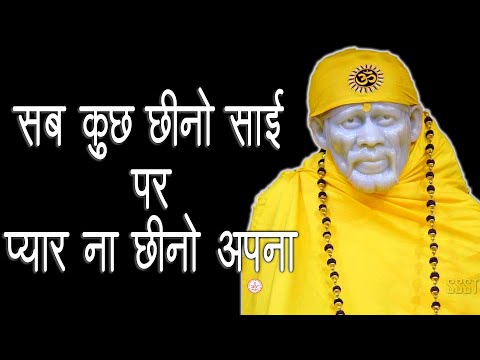
This devotee does not come with the arrogance of a renunciate but with the tears of a beggar. He realizes that mere physical renunciation is a farce if the mind remains entangled. He sees himself as a drop that has left the Gangotri of the soul, seeking the ocean of the Divine, yet terrified of the stones and mountains in between. In his desperation, he makes a bold, terrifying prayer: 'Sab Kuch Cheeno Sai'—Snatch everything away, O Lord. Since I lack the strength to give it up voluntarily, use your force. Bludgeon my ego, break my chains, and forcibly liberate me from the illusions I cling to. This is not a song of gentle praise, but the cry of a soul asking for the ultimate surgery—to sever the attachment to the world so that only the attachment to the Feet of the Master remains.
? The Conflict / Doubt
How can a devotee attain the supreme joy of Bhakti (devotion) when they are hopelessly entangled in Maya (worldly attachment) and lack the willpower to renounce it?
The conflict arises from a deep self-realization: The devotee desires Baba but is equally addicted to the pleasures of name, fame, and family. They fear that their worship is hypocritical because, while they perform rituals externally, their internal priority remains the world. The question haunts them: 'If I cannot leave the world, how can I ever truly belong to Sai?'
The Revelation
The path to liberation described here is not through ego-driven asceticism, but through total, helpless surrender to the Guru's power.
-
The Prayer of Forceful Grace: The devotee acknowledges that self-effort has failed. The solution is to invite Baba to be the active agent of renunciation. The prayer is specific: 'Take away every possession, every comfort, and every relationship that acts as a roadblock to my devotion.'
-
True Renunciation vs. Escapism: The teaching clarifies that wearing ochre robes or running to the Himalayas is often a deception ('Tan ko jogie sab kare, man ko na koi'). True renunciation is living amidst the family like a lotus in the mud—fulfilling duties without selfishness. One must pluck the 'flowers' of attachment from where they grow (greed, lust, pride) and string them into a garland to offer Baba. This is the only garland He desires.
-
The Internal Storm: The greatest danger is not external calamity, but the internal storm of involuntary sinful impulses. In these moments, when the boat of faith wavers, the devotee must cry out for Baba to be the 'oar of protection.'
"Take everything away, Sai, but do not take away your love... If that drop falls into the ocean, it will be called the ocean."
Scriptural References
📖 Sai Satcharitra Chapter 10 (Baba's humility: 'I am your servant's servant'), Kabir Dohe ('Tan ko jogie...'), Marathi Abhang ('Sai pasun shan hi vibhakt')
Watch the Discourse
In the vast theater of spiritual seeking, a poignant drama unfolds within the heart of a devotee. He stands before the merciful Sai Baba, torn by a profound duality. He describes his helpless state wi...
Leela Narration
In the vast theater of spiritual seeking, a poignant drama unfolds within the heart of a devotee. He stands before the merciful Sai Baba, torn by a profound duality. He describes his helpless state wi...