
The Price of Brahma Jnana: The Mystery of the Five Rupees
The Leela
In the 16th Chapter of the Sai Satcharitra, a wealthy merchant, deeply engrossed in accumulating material riches, hears of Sai Baba's fame. Driven by a superficial curiosity rather than a burning thirst, he hires a tonga for a quick round trip to Shirdi, desiring the immediate attainment of Brahma Jnana (Knowledge of the Ultimate Reality). Despite his friend's warning that a miser cannot grasp the Divine, he rushes to Baba's court.
Upon arrival, he impatiently demands, "Baba, give me Brahma Jnana." Baba, with a playful yet piercing smile, agrees, saying, "Do not worry, I will show you Brahma immediately. Many come asking for money, health, or status, but rare is the one who asks for the Ultimate."
However, instead of delivering a lecture, Baba creates a diversion. He calls a boy and sends him to borrow five rupees from Nandu Marwari. The boy runs off and returns empty-handed; Nandu is absent. Baba sends him to Bala Wani, and then to others, but the five rupees cannot be found anywhere. The wealthy merchant, growing restless as the meter on his hired horse ticks away, says, "Baba, please give me the knowledge quickly; I cannot stay long."
At this, Baba reveals the mirror to the man's soul: "My dear friend, I have been trying to give you Brahma Jnana all this while. You have fifty times five rupees in your pocket, yet you could not bring yourself to lend me a mere five. How can a man so bound by greed, unwilling to part with the smallest coin, hope to grasp the Infinite?"
? The Conflict / Doubt
Can the highest spiritual enlightenment (Brahma Jnana) be attained by a mind that is still enslaved by worldly attachment and greed? The conflict arises when a seeker treats spirituality as a transaction—demanding the highest realization while refusing to sacrifice even the smallest part of their ego or material possessiveness.
The Revelation
Baba's demand for "Five Rupees" was never about currency; it was a profound metaphorical demand for total surrender. As explained in Verse 73, the five rupees represent the five essential aspects of the self that must be offered to the Sadguru:
-
The First Rupee: The Five Pranas (Vital Airs) This is not about physical death, but a spiritual intensity. It represents the "suffocation" of regret one feels when repeating mistakes despite knowing better. When the remorse for one's ignorance becomes as desperate as a drowning man gasping for air, the Pranas are truly offered.
-
The Second Rupee: The Five Senses (Panchendriya) This is the surrender of the craving for sensory objects—sound, touch, form, taste, and smell. It is the conscious effort to withdraw from the relentless pursuit of pleasure.
-
The Third Rupee: The Mind (Manas) The mind is the seat of the six vices (lust, anger, greed, etc.) and endless thoughts. Offering the mind means surrendering these vices and the resolution of thoughts to the Guru.
-
The Fourth Rupee: The Intellect (Buddhi) This requires surrendering the arrogance of reasoning. It is the readiness to lay down one's logic and decision-making power at the Guru's feet, trusting His wisdom over one's own analysis.
-
The Fifth Rupee: The Ego (Ahankar) The root of the other four. The ego is the sense of "I-ness" and doership. Offering this means being ready for the dissolution of the separate self.
"Brahma lagi panch pran, panch panchendriya gyan, ahankar budhhi mann, lagti samrpan karavaya."
Baba teaches that Karma Yoga (selfless action), Bhakti Yoga (devotion), and Jnana Yoga (knowledge) are not separate paths but complementary layers of the same journey. One cannot cheat in spirituality; to gain the All, one must give the All.
Scriptural References
📖 Sai Satcharitra Chapter 16, Verse 73, Verse 167
Watch the Discourse
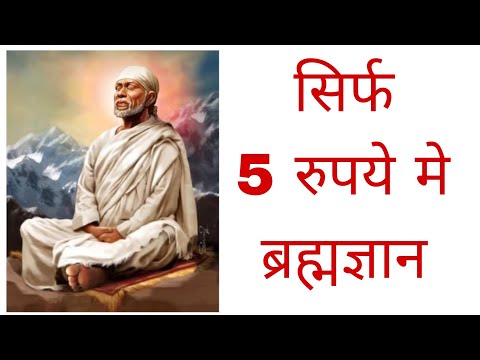
In the 16th Chapter of the *Sai Satcharitra*, a wealthy merchant, deeply engrossed in accumulating material riches, hears of Sai Baba's fame. Driven by a superficial curiosity rather than a burning th...
Leela Narration
In the 16th Chapter of the *Sai Satcharitra*, a wealthy merchant, deeply engrossed in accumulating material riches, hears of Sai Baba's fame. Driven by a superficial curiosity rather than a burning th...