
The True Parikrama: From Shirdi's Streets to the Heart's Center
The Leela
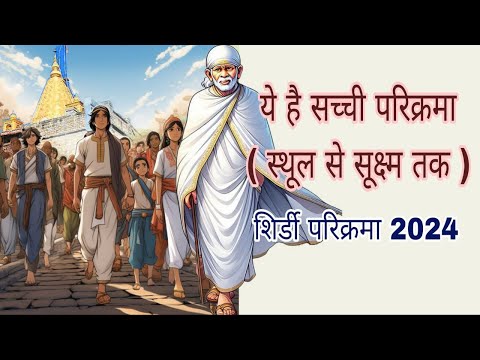
On February 13th, the sacred town of Shirdi prepares for a grand tradition—the circumambulation (Parikrama) of the holy land. It is said that the very dust of Shirdi is sanctified, for Baba breathed, walked, and purified this earth for sixty years. Hemadpant, in the Sai Satcharitra, proclaims that Shirdi itself is our Pandharpur, our Jagannath Puri, our Kashi, and our Rameshwar. 'Blessed are those stones and the grass in Shirdi which without effort kissed Baba's feet,' the scriptures remind us.
Yet, as thousands of devotees gather to physically walk this path, a deeper invitation is extended. While the feet tread upon the earth, where is the mind wandering? The speaker guides the congregation not just to walk the perimeter of the temple, but to understand the intrinsic journey from the gross physical form to the subtle realms. The physical act is merely the beginning; the destination is a state of consciousness where the devotee becomes a moving temple, circling the Divine presence enthroned within their own heart.
? The Conflict / Doubt
Is the act of Parikrama (circumambulation) merely a physical ritual of walking around a holy site, or does it demand a more rigorous internal discipline? The conflict arises when a devotee must balance the overwhelming duties of worldly life—family, career, society—with the desire for Sadhana (spiritual practice). Can one truly orbit the Divine while fully immersed in the mundane world?
The Revelation
The essence of the teaching lies in moving from physical proximity to mental surrender. True circumambulation is not just walking around a tomb, but making Sai the center of gravity for the mind.
- The Subtle Parikrama (Sukshma Parikrama): Physical rituals must evolve into an internal state. Just as one orbits a temple, the mind must orbit Sai while the body performs worldly duties.
- Duty as Worship: One should not run away from the world to find the Truth (Paramarth). Instead, one must fulfill responsibilities towards family and society perfectly, yet remain detached.
- The Lover's Focus: The speaker uses the analogy of a young lover. Though they perform household chores and listen to elders, their mind is constantly, secretly absorbed in thoughts of their beloved. This singular focus is required for Sai.
- The Miser's Treasure: Referencing the Satcharitra, the mind should be like a miser who, wherever he goes, constantly thinks of his buried treasure.
"Surrender your being at the feet of Sai... Be your form in my mind and your name on my mouth... let the duties be done with these hands ceaselessly but mind should be engrossed at your feet Baba."
Scriptural References
📖 Shree Sai Satcharitra: Chapter 4 (Verses 58-61), Chapter 10, Chapter 3 (Verse 185).
Watch the Discourse
On February 13th, the sacred town of Shirdi prepares for a grand tradition—the circumambulation (Parikrama) of the holy land. It is said that the very dust of Shirdi is sanctified, for Baba breathed, ...
Leela Narration
On February 13th, the sacred town of Shirdi prepares for a grand tradition—the circumambulation (Parikrama) of the holy land. It is said that the very dust of Shirdi is sanctified, for Baba breathed, ...