
Who is More Sanatani Than Sai? Unveiling the Eternal Truth
The Leela
There was once a destitute man, nearly ninety years old, living out his final days in abject poverty. He wore rags, dwelling in a broken hut, never knowing if he would find his next meal. His life was a long sigh of suffering. As his breath began to falter in his final moments, a great Saint arrived at his door seeking alms.
Looking at the dying man, the Saint did not offer pity but instead spoke with a piercing truth: "What should I say about your misfortune? You are truly unfortunate."
The dying pauper, confused, asked, "Why do you speak like this? I have suffered all my life."
The Saint replied, "The hut in which you spent all your days of poverty sits upon a vast treasure buried beneath the earth. You spent your whole life sobbing on the very ground that held a heap of gold coins, yet you never dug deep enough to find it."
This parable mirrors the condition of many modern Sai devotees. We call ourselves educated, yet we are spiritually illiterate. We claim to love Baba, yet we do not open the Sai Satcharitra. We have the treasure of the ultimate scripture in our homes, yet we live and die in spiritual poverty, unable to answer the doubts of the world because we have never truly opened the chest of wisdom Baba left for us.
? The Conflict / Doubt
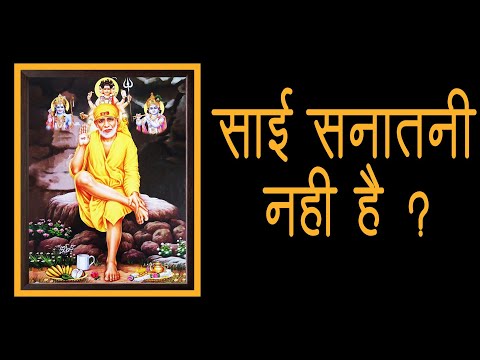
Is Sai Baba truly a follower of Sanatana Dharma (the Eternal Religion), or is he, as some modern propaganda claims, a non-believer sent to corrupt the Vedic faith?
Today, a wave of controversy spreads on social media claiming Baba was merely a "Chandmia" (a derogatory term implying he was a Muslim outsider) who ate meat and abused women, causing children to question their devoted parents: "Father, see what your Baba is saying? Why do we follow him?"
The Revelation
The speaker dismantles these accusations not with emotion, but with undeniable scriptural evidence. To ask if Baba is Sanatani is to misunderstand the very definition of Sanatana Dharma. It is the Eternal Religion, rooted in the Vedas, which declares Vasudev Kutumbakam (The World is One Family).
Here is the truth of Baba's alignment with the Vedic tradition:
-
The Definition of Sanatani: A true Sanatani is one who sees the underlying unity in diversity. As the Rig Veda states: "Ekam Sat Vipra Bahudha Vadanti" (Truth is one, though the wise call it by many names). Baba lived this principle, proving he was the ultimate Sanatani by embracing all faiths.
-
Sai Satcharitra as Essence of Vedanta: Baba did not just teach Vedanta; he simplified its profound depths through his Leelas.
-
Direct Scriptural Parallels in Sai Satcharitra:
- Pancha Suna (Five Great Sins): The Taittiriya Upanishad speaks of the five inevitable sins (killing germs while cooking, bathing, etc.) and the Pancha Maha Yagya (Five Sacrifices) to atone for them. Baba teaches this exact Vedic concept in Chapter 9.
- Shreya vs. Preya: The Kathopanishad distinguishes between the Path of the Good (Shreya) and the Path of the Pleasant (Preya). Baba expounds on this explicitly in Chapter 17.
- Ishavasya Upanishad: The profound non-dualism of this Upanishad is the core theme of Chapter 20.
- Guru Tattva: The Bhagavad Gita (4:34) explains how to approach a Guru. Baba elaborates on this verse across Chapters 39 and 50.
-
Living the Synthesis: Though Baba lived in a mosque, he kept a constant fire (Dhuni) like a Vedic Agnihotri, allowed a Tulsi Vrindavan to grow, and rang bells like a temple. He renovated temples of Shiva and Ganesh in Shirdi.
"In this whole universe, if anyone has lived the Vedic teachings, then it is Saibaba... Who is more Sanatani than Sai?"
If we truly study the Sai Satcharitra, we will see that Baba is not destroying Sanatana Dharma; He is its most practical and profound embodiment.
Scriptural References
📖 Sai Satcharitra (Ch 9, 17, 20, 39, 50, 53); Rig Veda; Taittiriya Upanishad; Kathopanishad; Ishavasya Upanishad; Bhagavad Gita 4:34
Watch the Discourse
There was once a destitute man, nearly ninety years old, living out his final days in abject poverty. He wore rags, dwelling in a broken hut, never knowing if he would find his next meal. His life was...
Leela Narration
There was once a destitute man, nearly ninety years old, living out his final days in abject poverty. He wore rags, dwelling in a broken hut, never knowing if he would find his next meal. His life was...