
The Paradox of Obedience: Why Amir Shakkar's Good Deed Turned into a Nightmare
The Leela
Amir Shakkar was a wealthy merchant from Bandra, a man of means who made his fortune as a commission agent and, notably, a butcher. Despite his wealth, he lived in agony, crippled by severe arthritis and joint pain—a condition the transcript identifies as an auto-immune disorder where the body fights itself. Having exhausted all medical treatments without success, he sought refuge at the feet of Sai Baba in Shirdi.
Baba prescribed a peculiar cure: no medicine, but a mandatory confinement. Amir was ordered to stay exclusively in the Chavadi for nine months, prohibited from even visiting Dwarakamai. At that time, the Chavadi was in a dilapidated state—damp walls, broken floors, and a roofless shelter that housed snakes, scorpions, and frogs. It was a rigorous imprisonment, akin to a child wriggling in the womb, enduring extreme conditions for rebirth.
Amir endured the hardship for some time, but eventually, his patience snapped. The dampness seemed to aggravate his Vata (wind) imbalance, and his mind rebelled. Without seeking Baba's permission, he fled in the dead of night, intending to catch a train from Kopargaon to Mumbai. While staying at an inn in Kopargaon, he encountered an old Fakir gasping with thirst. Moved by compassion, Amir offered him water. "Water is life," he thought, performing a meritorious deed. Yet, the moment the Fakir drank the water, he dropped dead.
Terror seized Amir. He feared being accused of murder as soon as the sun rose. Realizing his grave mistake in leaving the sanctuary of the Guru, he fled back to Shirdi under the cover of darkness, returning to the Chavadi before dawn, shaken to his core.
? The Conflict / Doubt
Giving water to a thirsty, dying man is universally considered a meritorious act of compassion (Punya). Why did this pious deed result in the Fakir's immediate death and bring such terror and misfortune upon Amir Shakkar?
The Revelation
This Leela unravels the profound mystery of Karma and the absolute necessity of obeying the Sadguru's command (Agya).
-
The Connection Between Intellect and Disease: The transcript reveals a deep spiritual diagnosis for Vata (auto-immune) diseases. It suggests that such ailments afflict those who have misused their God-given intellect to manipulate or harm others. Just as the body fights itself in an auto-immune response, the person has fought against the world (which is a part of them). Amir, a slaughterer by trade, had perhaps lacked compassion for the lives he took, and thus required a severe, 9-month "womb-like" penance in the harsh Chavadi to cleanse his karma.
-
The Principle of 'Anyatha Kartum': The actions of a Sadguru can be paradoxical. While logic suggested the damp Chavadi would worsen arthritis, Baba knew it was the spiritual containment required to burn the specific karma causing the illness.
-
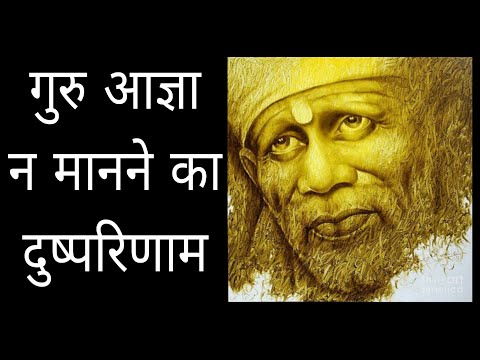
The Danger of Disobedience: The central teaching is that when one disobeys the Guru, even a virtuous act leads to disaster. Amir disobeyed Baba by leaving his post. Consequently, his act of giving water—usually a gateway to heaven—became a gateway to hell (fear of murder accusation).
-
Kabir's Wisdom: The transcript cites a Doha by Saint Kabir to explain Amir's predicament:
"Raja ki chori kare, rahe ranka ki oat." (If you steal from the King and try to hide in a beggar's hut, you cannot be saved.)
Turning away from the Guru's order is akin to stealing from the King of the Universe. No matter where one hides in the world, or what "good deeds" one attempts to perform to cover it up, the cosmic law (Kaal) will strike hard. The only safety lies in the shelter of the Guru's word.
Scriptural References
Sai Satcharitra Adhyay 22; Kabir Doha
Watch the Discourse
Amir Shakkar was a wealthy merchant from Bandra, a man of means who made his fortune as a commission agent and, notably, a butcher. Despite his wealth, he lived in agony, crippled by severe arthritis ...
Leela Narration
Amir Shakkar was a wealthy merchant from Bandra, a man of means who made his fortune as a commission agent and, notably, a butcher. Despite his wealth, he lived in agony, crippled by severe arthritis ...