
The Great Debate: Self-Effort, Grace, and the Necessity of a Living Guru
The Leela
In the sacred pages of the Sai Satcharitra, a profound intellectual clash unfolds in Chapter 2, echoing the eternal struggle within every seeker's heart. On one side stands Hemadpant, the advocate of Purushartha (human effort), declaring that spiritual progress is impossible without personal exertion. He argues, 'If a man spreads his legs and sleeps, doing nothing to purify his mind, what can even the greatest Guru give him?' On the other side stands Balasaheb Bhatte, the proponent of Prarabdha (destiny), asserting that without the Guru's grace, knowledge is unattainable, and whatever is destined to happen is inevitable.
This debate is not merely historical; it is alive in the mind of the modern devotee who asks, 'Do I really need a middleman? If Sai Baba is the Supreme Sadguru, can I not connect to Him directly?' The transcript weaves these threads together, moving from the argumentative courts of Hemadpant and Bhatte to the ultimate synthesis found in the later chapters of the Satcharitra, guiding us toward the confluence where the river of effort meets the ocean of grace.
? The Conflict / Doubt
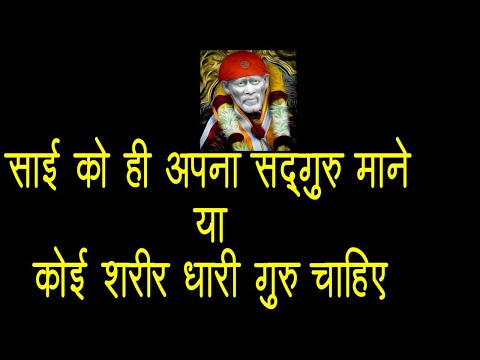
Is a physical Guru absolutely necessary for spiritual realization, or is one's own intellect and connection to the Divine sufficient?
Many devotees wonder: "If I have faith in Sai Baba, who is the formless Paramatma, do I still need a living Guru? Can I not surrender directly to Baba without a human intermediary?" This dilemma creates a conflict between the philosophy of self-reliance and the doctrine of total surrender.
The Revelation
The resolution to this spiritual paradox lies in the harmonious union of effort and grace, likened to the Triveni Sangam (confluence of three rivers). The transcript provides a multi-layered answer based on Baba's teachings:
-
The Synthesis of Effort and Grace: While Hemadpant argues for effort and Bhatte for destiny, the complete truth is revealed in Chapter 48, Verse 44. The spiritual equation is complete only when both meet:
"Karma matra me karnar, Samarth Hariguru phal denar." (I alone have the authority to perform the action, but only the capable Hari-Guru can grant the fruit.)
-
The Criterion for a Physical Guru: Baba clarifies the need for a physical guide in Chapter 11, Verse 10. The rule is simple yet profound:
"Pujak jetvar sakaru, dehdharich avashyak Guru." (As long as the worshipper identifies with the form and considers himself a body, a Guru with a body is absolutely necessary.)
-
The Barrier of Ego: The resistance to accepting a physical Guru often stems not from wisdom, but from ego—the refusal to bend. If one has truly transcended the body consciousness, they can indeed connect directly to the formless (Nirguna) Baba. However, if one is still trapped in body-consciousness, a physical guide is required to show the path.
-
Humility as the Key: Even Sai Baba, the incarnation of knowledge, set an example by humbly submitting to others to demonstrate that the one who burns the pride of the body (Dehabhiman) achieves the ultimate goal. If we drop our ego, we may find that there are many around us—perhaps even within 5 km of our homes—who possess greater wisdom and can serve as guides.
Scriptural References
📖 Sai Satcharitra: Chapter 2 (Verses 152, 157, 162), Chapter 11 (Verse 10), Chapter 48 (Verse 44).
Watch the Discourse
In the sacred pages of the Sai Satcharitra, a profound intellectual clash unfolds in Chapter 2, echoing the eternal struggle within every seeker's heart. On one side stands Hemadpant, the advocate of ...
Leela Narration
In the sacred pages of the Sai Satcharitra, a profound intellectual clash unfolds in Chapter 2, echoing the eternal struggle within every seeker's heart. On one side stands Hemadpant, the advocate of ...