
The Lost Essence of Padyatra: From Picnic to Penance
The Leela
In the days of yore, the spirit of the Padyatra (pilgrimage on foot) was woven with the threads of absolute surrender. Consider the speaker's maternal grandfather. Possessed by a divine longing, he would leave his wife and two children, stepping out into the unknown with a singular resolve: 'If I return, I am yours; otherwise, I belong to God.' Sometimes it took ten years, sometimes twelve. When he finally returned to his village, his hair was matted, his beard long, and his form so transformed by austerity that his own neighbors could not recognize him at the village well. It was only when his weeping wife washed the dust of travel from him that the husband was found again.
Contrast this with the humble story of Cholkar from the Sai Satcharitra. A poor man who vowed to offer sugar to Baba upon getting a job. Though he could not walk the miles, he walked the path of internal austerity. To save money for the offering, he stopped using sugar in his tea. He drank bitterness so he could offer sweetness to his Guru. When he finally arrived at Shirdi, Baba, the Knower of Hearts, turned to his host and commanded, > "Give him tea with plenty of sugar!"
Baba did not see the miles walked; He saw the sugar sacrificed. Yet today, the roads to Shirdi are filled with noise, lavish feasts, and festive distractions, where the walking feet are many, but the repentant hearts are few.
? The Conflict / Doubt
Does the physical act of walking hundreds of kilometers to Shirdi constitute a valid spiritual practice if the mind remains attached to worldly pleasures?
Many undertake the Padyatra believing the sheer physical exertion ensures merit, yet the journey often devolves into a social event filled with feasting and entertainment. One must ask: Is the destination the Samadhi Mandir, or is it the transformation of the walker's soul?
The Revelation
True spirituality is not measured by the callous on one's feet, but by the shedding of the ego's skin. The Chief Editor extracts the essence of a true pilgrimage through the lens of Anutap (repentance) and Tapa (penance).
-
The Empty Pitcher Philosophy: In ancient times, pilgrims carried an empty pitcher on their heads. It symbolized an empty mind, ready to gather the holy waters of rivers encountered on the way—waters of silence, goodwill, and tears of repentance—to be poured at the Sadguru’s feet. Today, we fill ourselves with lavish food instead of holy resolve.
-
Repentance is Mandatory: Baba warns us clearly:
"Anutapavin tirthatan... Shobha kavan tayachi." (Pilgrimage without repentance... what glory is there in that?) If one walks without the intent to cleanse inner vices—lust, addiction, and anger—the journey is merely a wandering.
-
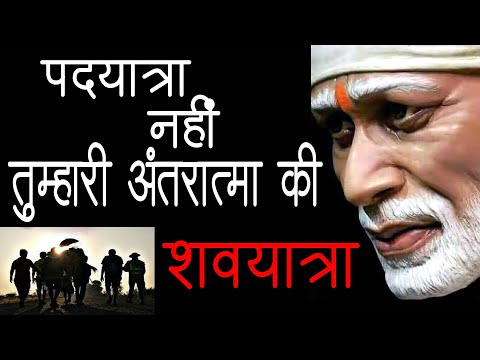
Internal Purification: The walk aims to untie the Granthi Jivanchi (knots of the heart). Every step should be a rhythmic shedding of impurities. If the journey is treated as a picnic, it is not a pilgrimage; it is, as the text starkly puts it, "the funeral of our inner Self."
-
The Divine Promise: You need not worry about reaching the physical temple. If your walk is fueled by genuine austerity and silence, Baba says:
"I will come running towards you... You do not have to go to the Samadhi temple; I will come in the middle."
Scriptural References
📖 Sai Satcharitra Chapter 14 (Verse 76), Chapter 4 (Verse 68), Chapter 38 (Verse 138), Chapter 43 (Verse 123), Chapter 15 (Cholkar's Story)
Watch the Discourse
In the days of yore, the spirit of the *Padyatra* (pilgrimage on foot) was woven with the threads of absolute surrender. Consider the speaker's maternal grandfather. Possessed by a divine longing, he ...
Leela Narration
In the days of yore, the spirit of the *Padyatra* (pilgrimage on foot) was woven with the threads of absolute surrender. Consider the speaker's maternal grandfather. Possessed by a divine longing, he ...