
The Living Scripture: Why Sai Baba is Rama and Krishna Incarnate
The Leela
In the swirling dust of modern discourse, where faith is often challenged by intellectual skepticism, a profound controversy arises: Can a Fakir in a tattered kafni be equated to the Supreme Avatars, Lord Rama and Lord Krishna?
The answer lies not in mere debate, but in the miraculous tapestry of Shirdi. Picture the quiet nights at the Masjid, where the boundaries of physical reality dissolved. In one instance, devotees froze in terror witnessing Khandayoga—Baba’s limbs separated from his trunk, scattered in the corners of the mosque, only to be seamlessly rejoined by morning. In another scene, the heat of the dhuni roared, yet Baba’s hand stirred boiling lentil soup as if it were cool water, emerging unburnt.
When the devoted Megha, seeing Shiva in Baba, sought to bathe him with the holy waters of the Godavari, Baba sat calm. Though Megha poured the water over the Master's entire body in a frenzy of devotion, a miracle unfolded: only Baba’s head was wet, while his body remained perfectly dry. And most profound of all, when the breath of life left him for three days during the 72-hour Samadhi, his body defied the laws of decay, remaining fresh and luminous until his spirit returned.
These were not magic tricks; they were the living manifestation of the Bhagavad Gita. Baba did not just recite scriptures; he was the scripture in motion.
? The Conflict / Doubt
Critics and intellectuals often argue that Sai Baba was merely a saint or a social reformer, and asserting that he is God—comparable to Lord Rama or Lord Krishna—is a misplaced exaggeration. How can a simple fakir hold the same status as the ancient Avatars?
The Revelation
The divinity of Sai Baba is not a matter of blind belief, but of witnessing the Atman (Soul) described in the scriptures manifesting in a human form. The transcript illuminates this through a direct correlation between Lord Krishna's words and Sai Baba's life:
-
The Indestructible Soul: Lord Krishna declares in the Bhagavad Gita (2:23) that the Soul cannot be cut, burnt, wetted, or dried. Baba proved he was that Supreme Soul through his actions:
- Nainaṃ chindanti śastrāṇi (No weapon can cut): Proven by Khandayoga, where his body was separated yet lived.
- Nainaṃ dahati pāvakaḥ (No fire can burn): Proven when his hand remained unburnt in the boiling pot.
- Na cainaṃ kledayantyāpo (No water can wet): Proven when Megha’s water bathed only his head, leaving the body dry by his will.
- Na śoṣayati mārutaḥ (No wind can dry/wither): Proven during the 72-hour Samadhi where his body did not decompose.
-
The Ideal of Rama: Just as Ramayana is the soul of the universe, demonstrating perfect equanimity in the face of lost kingdoms and exile, Baba lived a life of total renunciation. He taught that seeing Rama is not just about worship, but about recognizing the flaws of Ravana within ourselves and eliminating them.
-
Omnipresence: Baba echoed Krishna’s declaration of being the seed of all beings.
"I am a fakir... I have neither shape nor size. I am always everywhere... know that I like only him who sees Me in all living beings."
Therefore, we do not call him God out of confusion, but because he fully embodied the divine attributes of the Avatars.
Scriptural References
📖 Bhagavad Gita (2:23, 10:20), Sai Satcharitra (Chapters 7, 9, 28, 38, 44), Ramayana
Watch the Discourse
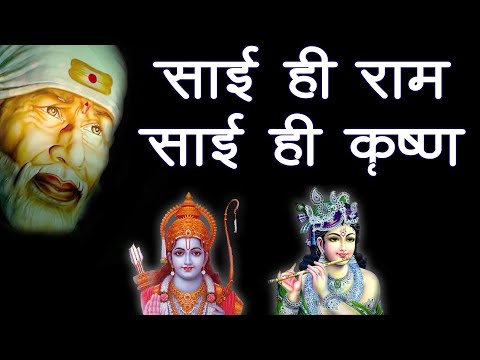
In the swirling dust of modern discourse, where faith is often challenged by intellectual skepticism, a profound controversy arises: *Can a Fakir in a tattered kafni be equated to the Supreme Avatars,...
Leela Narration
In the swirling dust of modern discourse, where faith is often challenged by intellectual skepticism, a profound controversy arises: *Can a Fakir in a tattered kafni be equated to the Supreme Avatars,...